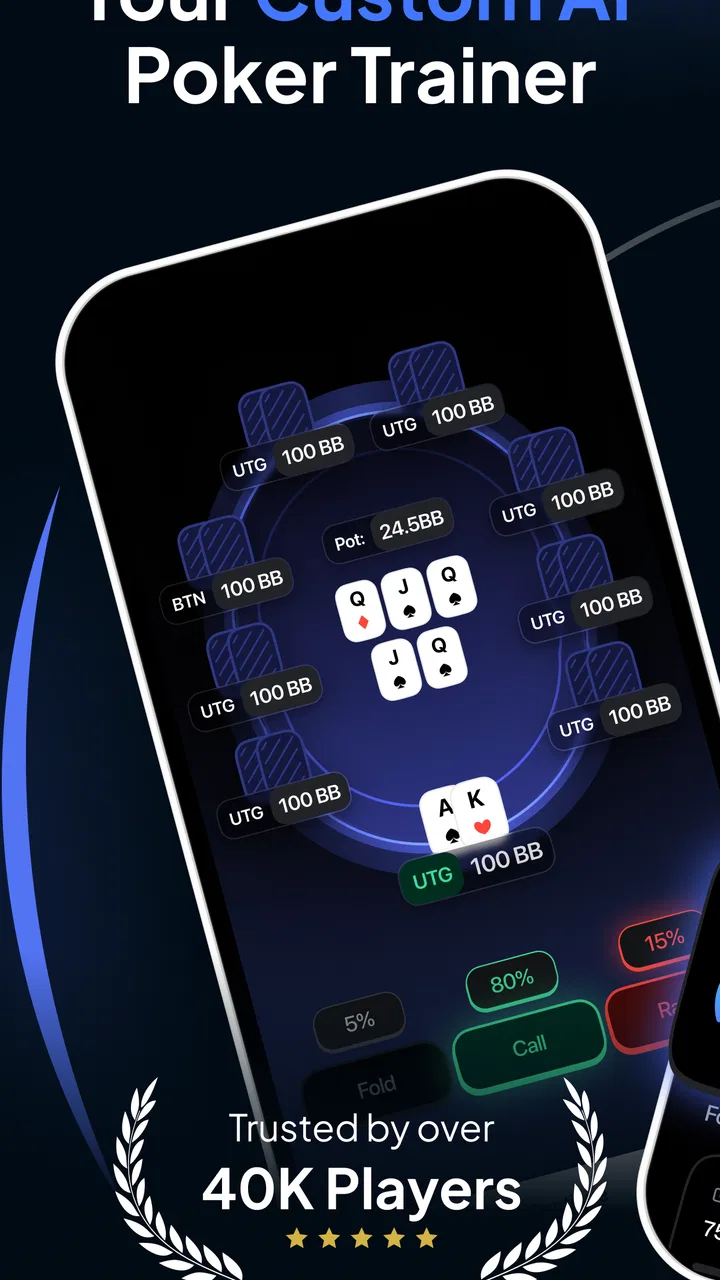
Runout Poker Trainer GTO Coach
- 4.6
- Rating
- 50.00K
- Installs
- Free
- Price

 Analysis by App-foxy
I approached Runout Poker Trainer GTO Coach as a study tool rather than a poker game. That distinction matters immediately. It is an Education app from Learn Poker Offline Labs, built around poker ranges, game-theory-oriented strategy, odds, and AI training. My first impression was that it is aimed at players who want to make better decisions away from a live table, not people looking for entertainment, social play, or a full poker-room experience.
The app is free to install, carries a Teen content rating, and has reached over 50 thousand installs. Its average score sits at 4.6 from roughly 4.4 thousand ratings, which suggests that the basic idea connects with a meaningful group of learners. I would still treat that score as a starting point rather than a guarantee, because a training tool can feel excellent to an intermediate player and unnecessarily demanding to someone who has not yet learned poker fundamentals.
What I would consider before choosing it
The most important question is not whether I want to “learn poker,” but what kind of learning I need. If I regularly hesitate over ranges, struggle to estimate equity, or make decisions based on instinct alone, this app has a clear purpose. It gives me a place to practice those specific skills without the pressure of risking chips or slowing down a real game.
You May Also Like

 Blood Strike: 2.5 Anniversary
Blood Strike’s Loadouts Turn Every Drop Into a Tactical Gamble
A close look at Blood Strike’s custom loadouts: how fast access to signature weapons reshapes its battle royale rhythm, rewards preparation, and narrows the gap between fights.

 Pandora - Music & Podcasts
Pandora’s Music Is Easy to Start, but Harder to Recover
Pandora’s strength is its low-effort path from a seed to a station. Its weak spot is how much confidence it asks you to place in connection, setup, and quiet recovery.

 8 Ball Pool
 Is Built on Rivalries, Rematches, and Routine
A close look at the rivalries, rematches, shared routines, and unanswered safety questions that turn a quick pool match into a persistent mobile community.

 Samsung Music
’s Quiet Strength Is Playing What You Already Own
Its reach comes less from spectacle than from dependable access to a personal library. That simplicity is both the app’s strongest retention engine and its ceiling.

 AccuWeather: Weather Radar
AccuWeather Review: A Quick, Clear Forecast for Everyday Decisions
For everyday plans, the best forecast is the one you can understand quickly. AccuWeather makes rain timing, radar, and local conditions easy to act on, with a few trade-offs.

 Hill Climb Racing
Why Hill Climb Racing Still Turns Crashes Into One More Run
A tiny car, a bumpy hill and one more upgrade: Hill Climb Racing keeps resurfacing because its simple chaos makes every near-miss feel personal.
More From Our News Desk
View All News


If my goal is to learn the rules, understand hand rankings, or play casually with friends, I would choose a beginner tutorial or a conventional poker app first. Runout Poker Trainer GTO Coach appears much more useful once I already understand the basic flow of a hand and want to improve the quality of my decisions. The GTO focus can be valuable, but it also creates a steeper entry point than a simple “how to play” guide.
I also considered how I prefer to study. Some players learn best through long explanations, charts, and written examples. Others improve by answering repeated situations and seeing where their thinking breaks down. This app is better suited to the second group. Its AI training concept makes practice feel more active than reading a strategy article, although active practice only helps when I pause to understand an error instead of rushing through the next prompt.
My practical test for any poker trainer is simple: can I use it in short sessions, identify a recurring leak, and carry one useful adjustment into my next game? That is a better standard than whether the app feels impressive during the first few minutes. A good training routine might focus on one range situation, review the reasoning behind mistakes, and then revisit the same topic later. Trying to absorb every strategic concept at once would make the experience far less effective.
Why the focused format works
The strongest part of the concept is its narrow focus. Rather than asking me to play an entire session, it puts attention on decisions that are easy to avoid at a real table. I can think about ranges and odds deliberately, without opponents waiting, distractions building, or the emotional effect of a recent loss influencing my answer.
That makes the app especially relevant for players who know what they should do in theory but fail to apply it consistently. For example, I might understand that a starting range changes with position, yet still call too widely when I am tired. Repeated training can expose that gap between knowledge and habit. The useful lesson is not merely remembering one answer; it is learning to notice the factors that should shape the answer.
The AI angle also gives the practice a more responsive feel than a static list of flashcards. I would not treat it as a replacement for a full coach or a complete strategic study system, but it can make repetition easier to maintain. The more often I return to a specific weakness, the more likely the lesson is to become part of my normal thought process.
Where it wins against ordinary poker study
Compared with watching poker videos, Runout Poker Trainer GTO Coach has a more direct relationship with my own decisions. A video can explain a concept clearly, but it is easy to nod along without discovering whether I would actually choose correctly under pressure. A trainer forces a response. That small moment of commitment is important because it reveals whether I understand the idea or merely recognize the vocabulary.
It also has an advantage over reading charts in isolation. Charts can show recommended ranges, but they do not automatically build the habit of considering the situation before acting. Used carefully, an interactive exercise can encourage me to ask why a hand belongs in a range, how the board affects the decision, and how odds should influence the result.
Against a standard poker game, the difference is even clearer. A game rewards immediate play and may teach through consequences, but losses do not always explain the underlying mistake. This app removes the money-game distraction and lets me concentrate on the decision itself. That is a genuine benefit for anyone who wants deliberate practice rather than another way to pass time.
One less obvious strength is that it can fit between other activities. I can use a short break to work on a narrow concept instead of needing a full table, a group of friends, or a long uninterrupted session. That makes it easier to build consistency. In poker study, regular contact with a difficult topic is often more useful than an occasional burst of enthusiasm.
How I would use it in a normal week
Imagine I play low-stakes poker on a weekend and notice that I repeatedly enter pots from positions where my range should be tighter. On a weekday evening, I could open the trainer and concentrate on range decisions rather than replaying every hand from memory. I would answer slowly, note the situations that feel uncertain, and stop after a manageable set instead of treating practice like a race.
Before the next game, I would revisit that same weakness and set one simple intention: make position part of every preflop decision. During play, I would not try to remember a giant collection of charts. I would focus on the one habit the practice exposed. Afterward, I could return to the trainer and see whether the same type of mistake still feels confusing.
This workflow is more useful than opening the app randomly and tapping through questions. The concrete insight is to use it as a feedback loop: identify a leak, train that leak, apply one adjustment, then check whether the problem remains. That approach also prevents a common mistake with GTO study, where players collect theoretical answers without changing their real decisions.
Understanding the GTO emphasis
Game-theory-oriented poker strategy can provide a disciplined reference point, but I would not confuse a reference point with an absolute command. Real games include opponents with different habits, table dynamics, and mistakes. A theoretically balanced decision may not always be the most profitable response to a particular player. The app is most valuable when I use its training to strengthen fundamentals and then combine that knowledge with observation.
For a newer player, the terminology may feel abstract. Ranges, runouts, and odds are easier to use when I already understand the basic rules and can follow a hand from beginning to end. If those ideas are still unfamiliar, I would first learn the foundations elsewhere and then return here for structured practice. That is not a weakness unique to this app; it is a consequence of choosing a focused strategy trainer instead of a broad introductory course.
I also think the app is better for decision quality than for personality-based coaching. It can help me practice patterns, but it cannot replace honest self-review after a session. I still need to remember what happened, question my assumptions, and recognize when emotions affected my play. The trainer can sharpen the technical side; it cannot do all of the reflective work for me.
Where another type of app may fit better
There are several situations in which I would select a different category of tool. A rules app is preferable for someone opening poker for the first time. A video course may suit a learner who needs a teacher to explain concepts slowly and visually. A hand-history or tracking tool may be more appropriate for a serious player whose main problem is reviewing past sessions rather than practicing isolated decisions.
A live poker app is also the better choice if my priority is social play, competition, or simply enjoying hands with other people. Runout Poker Trainer GTO Coach is not the substitute I would choose for that experience. Its value comes from study, and study can feel dry if I am expecting the excitement of a real table.
Even among training products, preferences will differ. Some players want extensive written theory, downloadable reference material, or a broad curriculum. Others want a quick drill they can repeat frequently. I would choose this app when the latter description sounds like me. If I need a complete poker education from absolute basics through advanced review, I would look for a broader learning path and use this trainer as one part of it.
The app’s current version is 1.1.17, and it requires Android 7.0 or later. That makes compatibility worth checking before I build a routine around it. The developer is Learn Poker Offline Labs, and the product’s positioning is clear enough that I would not expect it to behave like a general-purpose poker companion. Its identity is centered on training, which is helpful when choosing but limiting if my needs are wider.
Free access and the upgrade decision
The app is free, but in-app purchases range from $17.99 to $89.99 per item. That is the point at which I would slow down and decide whether the training has become part of my actual routine. I would not pay simply because GTO sounds advanced. I would first use the free experience long enough to determine whether the exercises are understandable, whether they target my weaknesses, and whether I return voluntarily.
The cost trade-off is not only financial. It is also the cost of switching from casual study to a more deliberate method. If I already rely on videos or notes, moving to an interactive trainer means changing how I prepare. I need to answer rather than watch, review rather than skim, and accept that repeated mistakes are useful evidence rather than a reason to quit.
My advice is to treat any purchase as a commitment to a study habit, not as a shortcut to better results. A premium option can be worthwhile for a player who practices consistently and knows what they want to improve. It is a poor choice for someone who is hoping one purchase will replace playing experience, coaching, and thoughtful review.
Small habits that make the training more effective
First, I would avoid guessing quickly. When an exercise presents a decision, I would name the factors in my head before choosing: position, range interaction, board texture, and odds. Even if the final answer is wrong, this process shows me which part of the reasoning failed.
Second, I would keep a very small list of recurring errors. Not a huge study journal—just a few patterns such as calling too often, ignoring position, or misjudging a draw. The app becomes much more useful when each session has a purpose. This is one of the less obvious trade-offs: more practice is not automatically better if it is unfocused.
Third, I would separate learning from proving myself. A trainer is most valuable when I allow it to expose uncertainty. If I only repeat topics I already understand, the sessions may feel comfortable but produce little improvement. Revisiting uncomfortable situations is slower, yet it gives the practice a stronger connection to real play.
Finally, I would use the app before a game for preparation and after a game for diagnosis, but not during a live hand. The point is to build judgment that I can carry into play, not to depend on constant prompts. That distinction helps preserve the value of the training when the table becomes fast or unpredictable.
Who should install it
I would recommend it to an intermediate poker player who wants structured repetition around ranges, GTO-style decisions, and odds. It is particularly appealing if I learn by doing, have limited time, and want practice that does not require joining a table. It can also suit a serious beginner who already knows the rules and is ready to study decisions rather than just memorize hand rankings.
I would be more cautious if I were completely new to poker, uncomfortable with strategic terminology, or mainly interested in social games. In those cases, the app may feel like starting in the middle of the subject. I would begin with a simpler introduction and return once the basic language of poker feels natural.
I would also skip it if I know I will not review mistakes. The interactive format can make practice feel productive even when I am tapping quickly and forgetting the reasoning. The benefit depends on attention. Players who want instant entertainment, a full playing environment, or a substitute for personal coaching should choose another kind of app.
My recommendation
After weighing the alternatives, I see Runout Poker Trainer GTO Coach as a focused study companion rather than an all-in-one poker solution. Its best quality is the way it turns abstract ideas—ranges, odds, and strategic balance—into decisions I have to confront. That makes it more actionable than passive content, especially when I use it to target a specific weakness.
Its limitations are equally clear. The strategy-first approach may be demanding for beginners, the training does not replace real-table judgment, and the optional purchases deserve careful consideration. I would start free, establish a repeatable practice routine, and only then decide whether the deeper investment matches my goals.
For me, the final decision is straightforward: install it if I want to study poker decisions in short, focused sessions and am willing to think about why an answer works. Choose a beginner course, a social poker game, or a review tracker instead if my needs are rules, entertainment, or detailed analysis of past hands. This app earns its place when practice is the goal, not merely playing more poker.
With its Teen rating, free starting point, and clear educational focus, it is easy to try without treating the first session as a major commitment. I would recommend approaching it patiently, using one topic at a time, and judging it by whether my decisions become more deliberate outside the app. That is the standard that matters most, and it is where this particular trainer has the strongest chance to help.
FAQs for Runout Poker Trainer GTO Coach
01What is Runout Poker Trainer GTO Coach, and who is it designed for?
Runout Poker Trainer GTO Coach is a poker study application focused on improving decision-making after the flop, particularly by helping players understand runouts, ranges, and game-theory-oriented strategy. It is aimed at players who already know the basic rules of Texas Hold’em and want structured practice rather than casual entertainment. Beginners may find it useful, although some familiarity with poker terminology, equity, and common post-flop situations will make the lessons easier to follow.
02How does the GTO coaching and training system work?
The app typically presents poker situations that require you to evaluate how a hand develops across later streets. You may be asked to consider possible turn and river cards, range interaction, equity changes, and the most strategically sound response. After answering, the trainer provides feedback so you can compare your decision with a game-theory-based approach. This format makes it useful for identifying recurring leaks, although it should be treated as a study aid rather than an automatic replacement for complete solver analysis.
03Do I need previous poker knowledge or experience to use the app effectively?
You do not need to be an advanced professional player, but basic poker knowledge is strongly recommended. Understanding hand rankings, positions, betting rounds, pot odds, ranges, and common actions such as checking, betting, calling, and raising will help you benefit from the exercises. Players completely new to poker may find the terminology challenging at first. It is best used after learning the fundamentals, when you are ready to improve strategic thinking and post-flop discipline.
04Is Runout Poker Trainer GTO Coach suitable for online and live poker players?
Yes, the strategic concepts practiced in the app can be relevant to both online and live Texas Hold’em. Thinking about how turn and river cards affect ranges, equity, and potential actions is useful regardless of where you play. However, real games include elements that a trainer cannot fully reproduce, such as timing tells, table dynamics, player tendencies, distractions, and bet-sizing differences. Use the app to strengthen your theoretical foundation, then adapt those ideas to the specific opponents and conditions at the table.
05Is the app free, and does it include in-app purchases or limitations?
Availability, pricing, and included features can vary depending on the platform, region, and version of Runout Poker Trainer GTO Coach. Before downloading, check the official Google Play or App Store listing for the current subscription details, free-trial conditions, locked training modules, advertisements, and any in-app purchases. If advanced drills or coaching tools require payment, review the renewal terms carefully. A free download does not always mean that every training feature is available without an additional purchase.
Pros
- Focused GTO drills help build stronger decision-making habits.
- Useful for reviewing common poker spots away from the tables.
- Training can be completed in short sessions.
- Clear feedback helps identify recurring strategic mistakes.
- Suitable for players improving preflop and postflop fundamentals.
Cons
- Advanced concepts may feel difficult for beginners to understand.
- Some training features may require a paid subscription.
- Solver-based advice may not match every opponent or table dynamic.
- Progress can feel repetitive without varied practice routines.
- A stable internet connection may be needed for some content.

Runout Poker Trainer GTO Coach
Gallery